Showing posts with label Helsinki. Show all posts

Friday, July 31, 2020

The Savoy Restaurant in Helsinki


Dear readers,

today I would like to present a very special Aalto site, one that I have kind of been saving for the end of this long journey, the glorious Savoy Restaurant in Helsinki. While the building itself, housing the restaurant on its top floor, wasn't designed by Alvar Aalto, it is the interior of the restaurant that features Aalto's special design.


Site No. 86: Interior and Furnishing of the Savoy Restaurant in Helsinki (1937)

In 1937 Alvar Aalto was commissioned by managing director of Ahström company Harry Gullichsen and his wife Maire Gullichsen to design the interior and furnishing of the Savoy Restaurant located on the top floor of the building owned by the Ahström family. In the following years Aalto designed also the well-known Gullichsen's home Villa Mairea in Noormarkku. The Savoy Restaurant is a high-class restaurant located right in the heart of Helsinki besides Esplanade Park, the actual Savoy Theater and across the street from the famous Kämp hotel. The restaurant is located on the 8. floor overseeing all of downtown Helsinki, Esplanade Park and providing magnificent views towards Finland's best known building, the white Helsinki Cathedral.


The sales team of the restaurant was so kind to arrange a special visit for me to give me the chance to photograph the restaurant and its interior outside its opening hours. I was even able to meet one of the staff members that was significantly involved in the latest renovation of the restaurant two years ago who could answer me the many detailed questions I had. In addition the chef the cuisine provided me with a private tour of the rooftop gardens for which the restaurant has become as well well-known in the recent years.


It was also the name of Savoy Restaurant that provided the name to Alvar Aalto's famous Savoy Vase which he originally designed as part of the restaurant's interior. It does not come at a surprise that every table in the restaurant is decorated with a Savoy Vase. However, also beyond the Savoy Restaurant, the Savoy Vase has become and icon as well as the trademark of Alvar Aalto and can nowadays been found in very Finnish home, including myself owning several pieces.


In the main dinning hall many well-known Artek classics can be found, however, the interior contains also many elements that have been designed for the restaurant exclusively. Such as there were the arm chairs which are still original from 1937. During the last renovation two years ago they have been carefully restored. Another highlight are the lamps on the roof which are lamps and ventilation at the same time. Both the roof and the lamps have as well been carefully restored two years ago. Also many of the tables have been renovated recently. Hereby the utmost was done to preserve as much from the original as possible while ensuring that the operations of a running restaurant are not compromised.


The long kanapee has received a new black and white fabric based on the famous Artek design.


Another highlight of the restaurant is the Marski table which was Finland's president during WWII marshal Carl Gustaf Mannerheim's favorite table. He was a regular at the Savoy Restaurant.


In the middle of the dinning hall there is also a serving table in the shape of the famous Savoy Vase.


Besides the dinning hall there is also a glassed roof terrace that features exclusive Artek furniture in addition to magnificent views. Especially worth mentioning here are the Artek chairs model 611 (Alvar Aalto, 1929) usually upholstered with fabric, however, here instead with leather. I was told that only the Artek shop in Tokyo sells exactly these same chairs.


At this point I would like to say a special thank you to the friendly staff of the Savoy Restaurant that provided me with the great opportunity to experience the great interior and furnishing at first hand. Finally, I would like to share one more picture of the magnificent view from the restaurant and its terrace provide over Esplanade Park and downtown Helsinki.


The Savoy Restaurant is open on weekdays and weekends serving both lunch and dinner. The restaurant provides a great opportunity to combine dinning in a Michelin Guide restaurant, with magnificent views of downtown Helsinki and an interior designed by Alvar Aalto preserved in its original form as of 1937.

Tuesday, August 20, 2019

Villa Kokkonen

Site No. 82: Villa Kokkonen in Järvenpää (1967-69)

After so many years of passing by Järvenpää on my way to Helsinki, today, I finally got off the train in order to visit another iconic masterpiece of Alvar Aalto's work. The building in question is no less than the former home of the well-known Finnish composer Joonas Kokkonen (1921-1996) for whom Aalto designed this house. The house is located just a few kilometers off the city of Järvenpää right on the shores of Lake Tuusula. This area is also known for housing the Finnish artist community at the turn of the 20th century. Famous Finnish writers, composers and painters such as Jean Sibelius, Aleksis Kivi or Eero Järnefelt resided in this area. Joonas Kokkonen was seen as one of the last representatives of this community and it comes at no surprise that he had his home erected here.


After Kokkonen had selected the right spot for his new home, he started to look for a suitable architect. Knowing Alvar Aalto through the Finnish Academy, of which both were members at the time, he asked Aalto for advice in finding an architect. Aalto understood this inquiry as a joke because he immediately offered his services, assuming that he was the architect Kokkonen had in mind at first. Kokkonen was not necessarily interested in receiving an extravagant building, like he had perceived Aalto's previous work until then. It is said that Kokkonen was at first not very happy with all the great ideas Aalto proposed. In the end, however, he gave Alvar Aalto free hands which Aalto in return in Kokkonen's favor by not charging him for his services at all. The purpose of the building certainly was to provide Joonas Kokkonen with a quiet space where he could compose. The center piece of the building is Kokkonen's grand piano itself. Aalto kind of designed the house around the instrument. The grand piano is located in a large room that is these days used for music performances and can easily host 30 listeners at a time.


The house itself was after Kokkonen's death purchased by the City of Järvenpää and is currently run by two very engaged entrepreneurs that keep the house open to the public. Besides guided tours they also organize, on a frequent basis, concerts as being musicians themselves. Each guided tour includes also a musical performance by the two hosts, featuring works of Kokkonen him selves. The house can be visited during the frequently organized guided tours without reservation or by making an appointment in advance. More information can be found here. I participated in one of the guided tours that provided interesting in-sights into the building, its history and its former owner. During the tour it was possible to explore the grounds as well as large parts of the buildings interior. Similar as with other private homes designed by Alvar Aalto such as Villa Mairea or Villa Schild it was not allowed to take photographs of the interior unless agreed with the organizers beforehand.


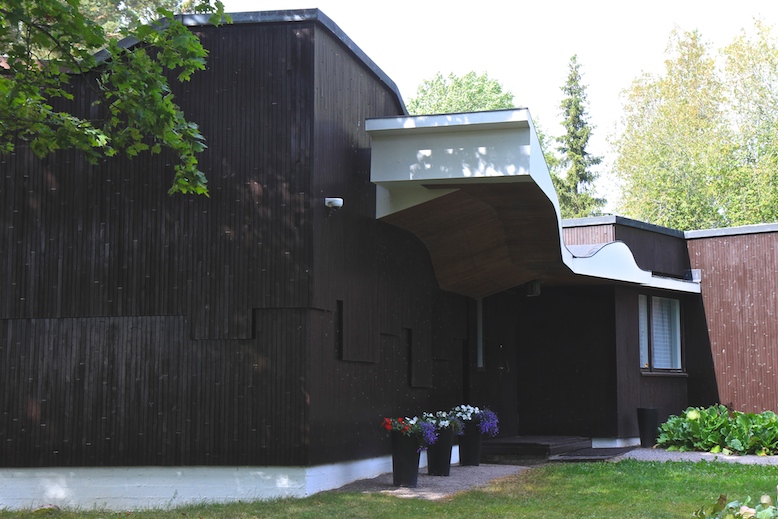
Villa Kokkonen opens up in a fan shape towards Lake Tuusula. The building is divided into three major areas, the large concert room with the grand piano, a center tract with living and dining room for receiving guests and a third more private wing that contains the bed rooms and space for personal. In addition there is a sauna, a garage and a small cabin for storage located on the grounds.


Right by the wooden sauna there is also a small pool that provides a beautiful view towards Lake Tuusula. 


Stairs are leading down towards the sauna, pool and garden. The roofing is kept in a very similar style as can be found at Villa Mairea with plans covering the columns.


The wooden coating of the building kept in dark brown reminded me instantly of the Finnish Pavilion at the Venice Biennale Aalto designed in the 1950s.


Järvenpää can easily be reached by local train from Helsinki. Take the R or H train from Helsinki Central Station and you will be in Järvenpää in just 30 minutes. From Järvenpää station it is about 3 kilometers to Villa Kokkonen. During weekdays and on Saturdays there is a direct bus connection from the railway station to the house with line 21. During my visit on a Sunday there was no bus connection, however, walking to the house didn't take me more than 30 minutes and finding Villa Kokkonen is fairly easy by just following the street signs. I was lucky enough to get a ride back to the station by one of the other visitors and my thanks and gratitudes go to her.


Villa Kokkonen is another great example of Aalto's outstanding talents and a must to visit if you are in Helsinki region or are visiting any of the other artists home of the Finnish artist community such as Jean Sibelius Ainola. The guided tour together with a musical performance and the delicious coffee served afterwards are definitely adding great value to the experience.

Friday, August 9, 2019

Finlandia Hall Update 2

The Finlandia Hall in Helsinki (1962-75)

It has been a long time since I reported last on the Finlandia Hall, however, finally this summer a long lasted dream of mine came true, I had the chance to take part in one of the guided tours of the Finlandia Hall in Helsinki! My previous update on the Finland Hall dates back to 2014 and my first visit even to 2011. For so many years I have been passing by or even through the Finlandia Hall but the upper floors and especially the concert hall remained always unreachable to me. Only a guided tour opened finally the doors for me to see those special halls. For those who want to see more of Finlandia Hall than just the exterior and the lobby this tour is a must. Alternatively, there is of course the chance to attend one of the many events organized in Finlandia during the year, however, it is the guided tour that gives you the in-sights and let you go backstage.


The tour started in the lobby, which in itself is of course already a work of art. Here are first a few impressions before we enter the upper floors which are not open to the public on a daily bases.


The guided tour pointed out two interesting details in the lobby of the Finlandia Hall. One of them was the sculpture of Alvar Aalto that was installed in the Finlandia Hall as the only work of art at the time of its completion. Today, the building features a wast amount of art work, however, only this one sculpture of Alvar Aalto has been original to the building.


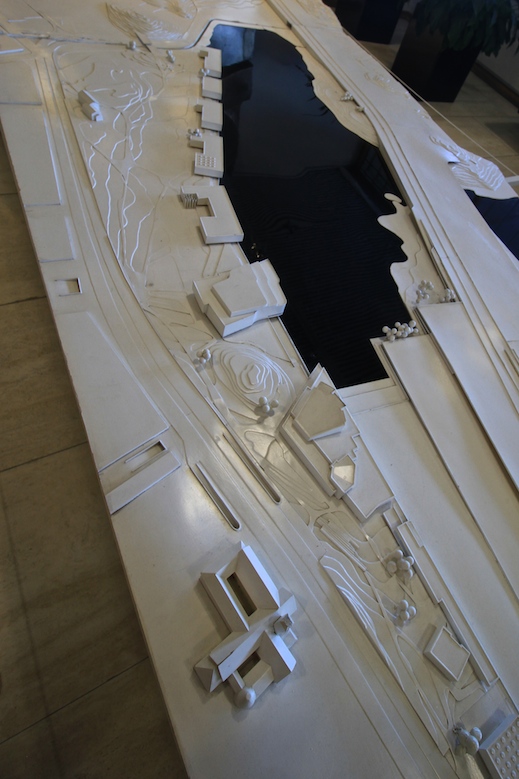
Another interesting detail is a scale model of the Töölö bay area that shows Finlandia Hall and all the other buildings Aalto had in mind for the area such as the Opera House. Unfortunately, in the end, it was only the Finlandia Hall that was built while the remaining buildings were not realized by Alvar Aalto. Some buildings, however, were later erected featuring the works of other great architects such as the Opera House by the Töölö bay.


However, finally it is time to reveal the pictures from the second and third floor as well as from the actual concert hall. The upper lobby can be reached through a wide staircase that provides already some idea of the sheer size of the upper lobby.


Here are now the pictures of the upper lobby.


An interesting detail is the carpeting of the lobby in the second and third floor which was kept in very soft material in order to reduce noise from the outside, disturbing the performances in the concert hall.  A further detail worth mentioning are the tables in the lobby and their special shape.


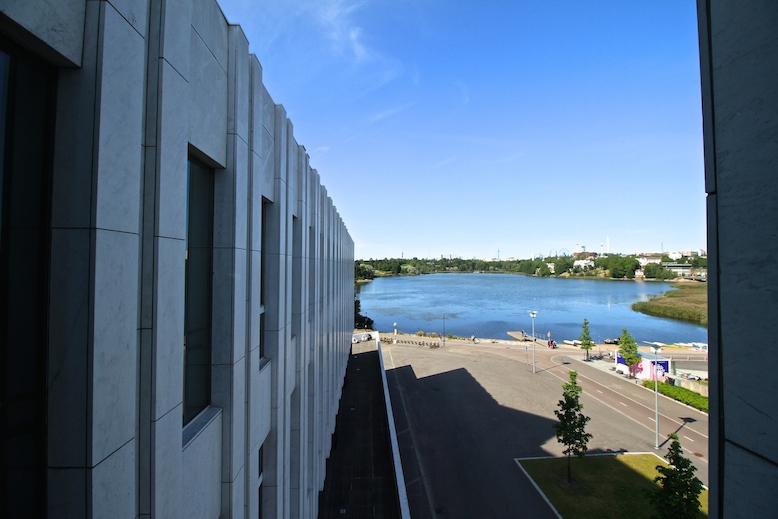
Two sets of stairs let to the third floor lobby and provide stunning views of the nearby Töölö bay right at the end of the staircases. The third floor lobby lacks not behind the glory of the lobby on the second floor.


Finally, it is time to take a look at the actual concert hall that I had wanted to visit for so many years and honestly I didn't get disappointed by what I found there. To be honest it was overwhelming to me.


As I already thought what could be greater than finally take a seat in one of the comfortable chairs (1,700 in total) in Finlandia Hall's great concert hall, it got even better. The guide let us to see the concert hall from the VIP balcony that is right above the stage and can be entered through a separate entrance and a VIP lounge which we of course were also allowed to see.


Entering the VIP balcony, that usually is mainly used by the President of Finland and his distinguished guests, gave me also the opportunity to have a closer look at the special wooden work of the blue piece of art that is attached to the walls of Finlandia Hall. The shapes and forms are just amazing!


After the guided tour had spent a significant amount of time in the great concert hall we took finally also a look at the second much smaller concert hall that was designed for camber music.


One interesting detail of the camber music hall are the panels put on the roof that are there for acoustic improvements. This I had in a similar function already seen in the Detmerode Church that I visited two years ago in Germany. The chairs were similar to the ones built into the great concert hall, however, in the camber music hall they were kept in red fabric in order to provide a more cosy atmosphere, suitable for camber music.


The tour of the second and third floor ended as we decent down to the main lobby through the staircase leading directly up to the camber music hall.


Through another stair case connecting the main lobby with the ground floor we reached Cafe Veranda where the tour ended. A free coffee/tea at Cafe Veranda was included in the participation fee and there was some time to ask further questions from the tour guide.


In summary I must say that the guided tour had exceeded my expectations. Not so much in what the guide told about Alvar Aalto and his works, as I am by now quite familiar with those, but in the fact that I had gained access to the upper floors of the Finlandia Hall and finally being able to see with my own eyes, what is often regarded as the greatest of Aalto's works.