Hi there!
During the last week of August (27.8-2.9.2018) the Aalto Foundation in collaboration with the City of Jyväskylä and other partners in the Central Finland region organized the very first Alvar Aalto Week in and around the Aalto City Jyväskylä. It was a fantastic week with a rich program and many great opportunities to have a look behind the scenes and get access to places that are normally not open to the public. I was lucky enough to find time to participate in many of the events and this post is dedicated to the first Alvar Aalto Week in Jyväskylä.
The week started off for me on Tuesday with the rare opportunity to visit the Aalto Foundation's archive that is located in Jyväskylä not far from one of Aalto's first realized projects, the
Nuora House, which I reported about earlier this year. Although the Aalto Foundation's chairmen had invited me already last year to visit the archive, I was glad that I had the chance to participate in one of the guided tours that were offered during this theme week. Indeed, I was lucky as I was the only participant in one of the hourly organized guided tours and received therefore a more customized tour based on my own needs and interests. It was impressive to see how many documents the archive has on file, we are talking here about tens of thousands of documents. These were not only all the original drawings and pictures taken of all the Alvar Aalto buildings but many more documents such as business letters as well as personal letters of Alvar Aalto, almost all publications ever produced about Alvar Aalto and even invoices his office had issued for their architectural services. This archive is certainly a gold mine for any researcher or historian who wants to understand better who Alvar Aalto was and how this translated into his work. I had a very inspiring conversation with the staff of the archive that helped me a lot in increasing my understanding of Aalto's work from a totally new perspective compared to the classic site visits and books that I have read about him and his work so far.

On Wednesday I visited the
Alvar Aalto Museum and participated in the free guided tour on the temporary exhibition: The Housing Problem - Alvar Aalto's Housing Architecture. The exhibition gave an interesting in-sight into Alvar Aalto's approach on housing, discussing both private houses and mansions as well as the housing of factory workers and the latter design of high-rise buildings. Although, I had visited almost all the buildings that had been presented in the exhibition, the guided tour gave me still some new understanding on certain aspects of this buildings and answered some of my questions that had remained open during the visits. What certainly stood out in the exhibition were the many original photos from the time when the buildings were completed as well as several scale models and original furnitures that were on display.


On Thursday I briefly visited the so-called Aalto Lounge that was compiled as a temporary exhibition in the Jyväskylä Art Museum consisting of furniture and other decorative elements designed by Alvar Aalto.

On Friday I participated in one of the guided bus tours which the City of Jyväskylä offered for free. Starting point of the three hours tour called Aalto Bravo was at the City Theater that was, as well, designed by Alvar Aalto. Although there were still plenty of tickets left the day before when I got mine, the bus was quite full when it left.
After viewing a few important Aalto buildings from the bus, such as the Administrative Center of Jyväskylä or the University Main Building, the bus made its way out of town to its first real destination, Säynätsalo. The town on the island is famous for its T
own Hall which is regarded as one of Aalto's most important works. I had plans to re-visit this site this summer because the purpose of the building had changed a bit since the city council and administration had moved out of the building. After the building had been standing partially empty for some time an entrepreneur had started to open the building again for the public with a new concept of turning the building into a tourist destination with exhibitions, a bakery-shop and rooms for rent. I was curious to see the changes and happy that the tour stopped for quite a while at the town hall. The guide even showed us around before there was time left to explore the building further on our own. It was nice to be able to access more of the rooms that were formally restricted to the employees in the building only. The Town Hall of Säynätsalo is certainly a masterpiece and it is nice to see that it is now better accessible to the public as well.


After leaving Säynätsalo the tour went on to another site that I had planned to re-visit as well, the
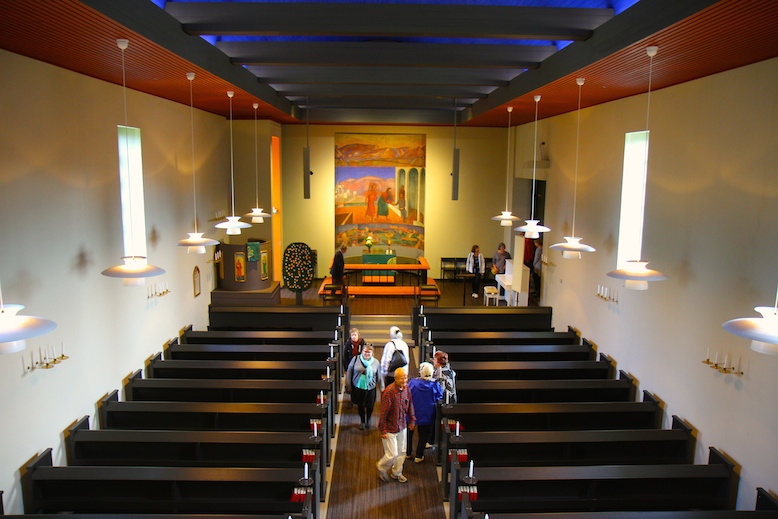
Muuramme Church. Since my last visit in 2011, the church had undergone major renovations and the ceiling and the benches had been repainted in the original colors, giving the church a totally different look.
You can still find
pictures on my 2011 post in case you want to compare the changes as such. The guide provided us with some interesting in-sights on the church and the renovation it had undergone. The main aim of the renovations was to bring the church as close as possible back to its original state as it was designed by Alvar Aalto. After the visit to Muuramme Church the bus returned directly to Jyväskylä where the tour ended.


One of the highlights of the week was certainly the last day. On Sunday visitors were able to view several apartments in four different Alvar Aalto buildings in Jyväskylä and Säynätsalo. This was certainly an event many local people had been looking forward for long and so did I. The cues at each building were long as everybody wanted to get a climbs of what it must be like to life in an Alvar Aalto building. The first building I visited was the
Viitatorni high-rise building.
For years I had dreamed of getting access to this building and one of its apartments. The chairperson of the Alvar Aalto Foundation was kind enough to let visitor to see his own studio apartment that is located in this building. The view from the 11th floor was quite impressive.

The second building open to the public that day was the
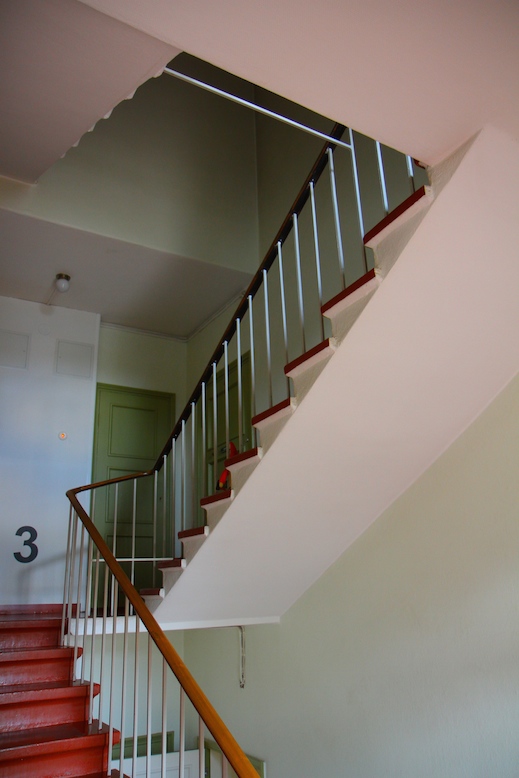
Aira Apartment House that was originally designed for railroad workers. Here the cue was even longer and some had to wait up to one hour to enter the building. In this building a three room apartment was on display and I was also approached by a journalist who asked me about my opinions on the building. Although my name was not mentioned, my comments were printed the next day in the local newspaper.


Finally, the third building that provided visitors with access was the
Alvar Aalto Museum itself. However, this meant not only the regular exhibition space but also the small apartment in the back of the building that was originally designed to accommodate the janitor of the building.

Today, the two room apartment is occupied by the Aalto Foundation and mainly used as office space. The second room, however, is kept as a guest room for visitors of the foundation and shows still many elements of Alvar Aalto's original design.
All in all the Alvar Aalto Week was quite exciting as it provided many interesting in-sights and access to some spaces that I had hoped for quite some years to finally be able to see. I really hope that the organizers will consider to put up similar events also in the future. One could certainly see the large interest among the general public and important role Aalto and his work still plays in this city even decades after his career ended.