Showing posts with label Villa. Show all posts

Tuesday, August 20, 2019

Villa Kokkonen

Site No. 82: Villa Kokkonen in Järvenpää (1967-69)

After so many years of passing by Järvenpää on my way to Helsinki, today, I finally got off the train in order to visit another iconic masterpiece of Alvar Aalto's work. The building in question is no less than the former home of the well-known Finnish composer Joonas Kokkonen (1921-1996) for whom Aalto designed this house. The house is located just a few kilometers off the city of Järvenpää right on the shores of Lake Tuusula. This area is also known for housing the Finnish artist community at the turn of the 20th century. Famous Finnish writers, composers and painters such as Jean Sibelius, Aleksis Kivi or Eero Järnefelt resided in this area. Joonas Kokkonen was seen as one of the last representatives of this community and it comes at no surprise that he had his home erected here.


After Kokkonen had selected the right spot for his new home, he started to look for a suitable architect. Knowing Alvar Aalto through the Finnish Academy, of which both were members at the time, he asked Aalto for advice in finding an architect. Aalto understood this inquiry as a joke because he immediately offered his services, assuming that he was the architect Kokkonen had in mind at first. Kokkonen was not necessarily interested in receiving an extravagant building, like he had perceived Aalto's previous work until then. It is said that Kokkonen was at first not very happy with all the great ideas Aalto proposed. In the end, however, he gave Alvar Aalto free hands which Aalto in return in Kokkonen's favor by not charging him for his services at all. The purpose of the building certainly was to provide Joonas Kokkonen with a quiet space where he could compose. The center piece of the building is Kokkonen's grand piano itself. Aalto kind of designed the house around the instrument. The grand piano is located in a large room that is these days used for music performances and can easily host 30 listeners at a time.


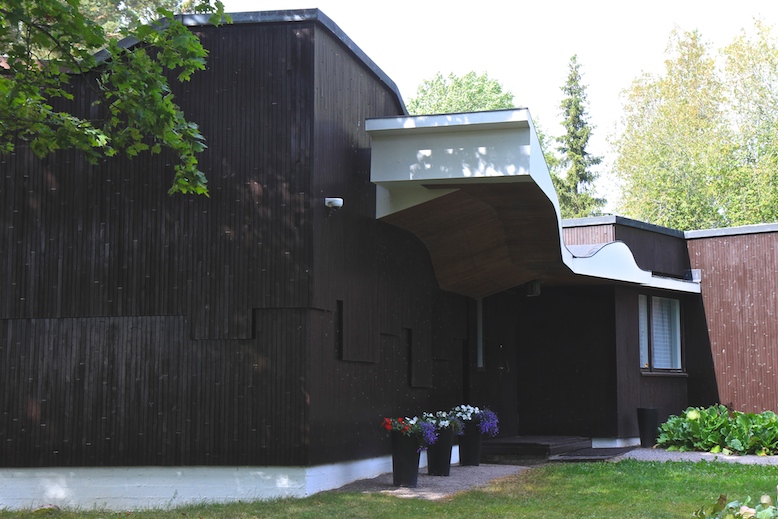

The house itself was after Kokkonen's death purchased by the City of Järvenpää and is currently run by two very engaged entrepreneurs that keep the house open to the public. Besides guided tours they also organize, on a frequent basis, concerts as being musicians themselves. Each guided tour includes also a musical performance by the two hosts, featuring works of Kokkonen him selves. The house can be visited during the frequently organized guided tours without reservation or by making an appointment in advance. More information can be found here. I participated in one of the guided tours that provided interesting in-sights into the building, its history and its former owner. During the tour it was possible to explore the grounds as well as large parts of the buildings interior. Similar as with other private homes designed by Alvar Aalto such as Villa Mairea or Villa Schild it was not allowed to take photographs of the interior unless agreed with the organizers beforehand.


Villa Kokkonen opens up in a fan shape towards Lake Tuusula. The building is divided into three major areas, the large concert room with the grand piano, a center tract with living and dining room for receiving guests and a third more private wing that contains the bed rooms and space for personal. In addition there is a sauna, a garage and a small cabin for storage located on the grounds.


Right by the wooden sauna there is also a small pool that provides a beautiful view towards Lake Tuusula. 


Stairs are leading down towards the sauna, pool and garden. The roofing is kept in a very similar style as can be found at Villa Mairea with plans covering the columns.


The wooden coating of the building kept in dark brown reminded me instantly of the Finnish Pavilion at the Venice Biennale Aalto designed in the 1950s.


Järvenpää can easily be reached by local train from Helsinki. Take the R or H train from Helsinki Central Station and you will be in Järvenpää in just 30 minutes. From Järvenpää station it is about 3 kilometers to Villa Kokkonen. During weekdays and on Saturdays there is a direct bus connection from the railway station to the house with line 21. During my visit on a Sunday there was no bus connection, however, walking to the house didn't take me more than 30 minutes and finding Villa Kokkonen is fairly easy by just following the street signs. I was lucky enough to get a ride back to the station by one of the other visitors and my thanks and gratitudes go to her.


Villa Kokkonen is another great example of Aalto's outstanding talents and a must to visit if you are in Helsinki region or are visiting any of the other artists home of the Finnish artist community such as Jean Sibelius Ainola. The guided tour together with a musical performance and the delicious coffee served afterwards are definitely adding great value to the experience.

Saturday, April 6, 2019

Aalto in Rovaniemi - Update

Hi there,

after a seven year's break I made again my way to visit Finnish Lapland. Passing through the capital of Lapland, Rovaniemi, I had the chance to visit once again the Administrative and Cultural Center designed by Alvar Aalto. In addition, I had also the possibility to visit the two missing Aalto sights in Rovaniemi which are less well known and to which I hadn't pay much attention during my last major visit in the summer of 2011. But before presenting the two new sights, I first want to share a few current pictures taken from the Administrative and Cultural Center in Rovaniemi, containing the Lappia Hall, the Rovaniemi Library and the Town Hall of Rovaniemi.


The Administrative and Cultural Center in Rovaniemi is a must visit for anybody interested in Alvar Aalto's work as these are certainly among the finest buildings Aalto has designed.


Site No. 77: Maison Aho in Rovaniemi (1964-65)

Between 1958 and 1963 Aalto designed three commercial and residential buildings for the local business man Aarne Aho which I presented in an earlier post on Aalto sites in Rovaniemi. These buildings can be found right in the city centre of Rovaniemi, located in Koskikatu. A bit further down the same street Aalto also designed a private house for the Aho family which is less well known and I was not aware of this building during my previous visit in Rovaniemi. The exact address is Pohjolankatu 32.


The building dates from Aalto's late red brick phase as it was erected in the mid 1960s. It stands in a spacious garden-like surrounding, however, as like many other private houses designed by Alvar Aalto, only the main entrance and a window can be seen from the street. Most of what the outside visitor can see from the building are red brick walls. The house is private property and unfortunately not open to the public. It can only be viewed from the street.


Unless Villa Mairea and Maison Carre, Maison Aro shares in common with these brilliant Aalto works the fact that all three private buildings house art collections. According to local sources the floor plan of the building is slightly fan-shaped, opening out into a living room with a large corner window. A curving gallery wall, lit by a skylight provides indirect natural light to the artworks.


Although the house can only be viewed from the outside, as it is only a few meters from the actual city centre of Rovaniemi away a brief visit to see the exterior is recommended as long as one respects the fact that this is a private house.


Site No. 78: Korkalorinne Housing Area in Rovaniemi (1956-60)

Another Aalto site I was not aware of during my last Rovaniemi visit is the Korkalorinne Housing Area located in the Korkalorinne district. Korkalorinne is about two kilometers from the city centre of Rovaniemi away but can easily be reached by foot. Just follow local signs towards Korkalorinne, it is a nice walk through a quiet residential area with beautiful wooden houses build after the war.


Korkealorinne Housing Area was designed by Alvar Aalto in the mid-late 1950s in an effort to respond to the post-war housing shortage. The majority of Rovaniemi got destroyed during the second world war and the lack of housing was a huge problem at that time. The entire housing area consists of two four-story apartment blocks and three two-storey terraced houses.

Departing from Rovaniemi


Although my visit to Rovaniemi was rather brief this time, I am glad that I had the chance to catch up on the still missing Aalto sites and take a look at some of his less well known works.


Thursday, July 12, 2018

Aalto and Tammisaari

Hi there,
Departing Jyväskylä

just a few days ago I did a nice day trip to the city of Tammisaari which is located at the south-west coast of Finland. What is special about this small 15,000 people town is the fact that it is home to two Aalto buildings, a private home and a commercial building. While the commercial building is quite well know the private home has more been of a hidden spot. This was also due to the fact that the original owner, for whom Aalto had designed the house, had been living in the building until the beginning of this year. Because coming of age the owner moved at the beginning of 2018 to a flat and the house was finally opened to the public. Now the Christine and Göran Schildt foundation is taking care of the house and offers a limited amount of guided tours during this summer. Thanks to a work colleague who has read about those guided tours in the newspaper and alerted me I was able to attend one of those few and rare tours. Although the tours are still running until July 19th, they are all sold out by now. I was lucky enough to still get a spot in one of the tours.


However, coming the long way from Jyväskylä, I almost missed the rare chance to attend the booked tour because of a train delay due to a technical fault. Luckily I had booked tickets for the first train from Jyväskylä to Tammisaari departing at 5.28 am in order to be on time for the booked tour at noon. While I supposed to arrive in Tammisaari at 10.02 am, I just arrive on the spot a few minutes before the tour started at 12. Luckily the train company paid for a taxi that drove right to house.


Nevertheless, I still recommend to use the train in order to reach Tammisaari. About 100 kilometers from Helsinki to the west Tammisaari is a comfortable day trip destination and this lovely coastal town has certainly more to offer and to do besides visiting Aalto's great works. It takes about 1.5 hours from Helsinki to Tammisaari by train including one quick change in Karjaa. From the station all sighs are within walking distance.


Site No. 75 Villa Schildt in Tammisaari (1969)

Villa Schildt, as named after the owner and close friend of Alvar Aalto, was one of Aalto's last works. Villa Schildt is in fact the last and the smallest private house Aalto ever designed. The building is also known under the name Villa Skeppet ('ship' in Swedish) which was formed by the local Swedisch speaking residents and also used by the owners although the official name of the building remains Villa Schildt. The name most likely came from the fact that the house had a bit the shape of a ship.


The house is located on Östra Strandgatan 6 in a quiet residential area close to the coast and only a couple of hundred meters away from the actual center and old town of Tammisaari.


As already mentioned Alvar Aalto and the owner of the house Göran Schildt were close friends. In fact Schildt, an art historian and writer, published in 1970 a biography about Alvar Aalto's work and life in four volumes which is probably until today among the greatest works that has been published on Alvar Aalto. Due to the age difference of 20 years but also due to the lack of a father figure, Aalto was like a father to Göran Schildt. What linked them both was their love for the Mediterranean.


While Aalto was designing the commercial building in Tammisaari he discovered the perfect building ground for the house. Aalto wanted to built a house for Schildt in order to bring him back to Finland. Schildt had lost his parental home just a few years earlier and spend most of his time abroad.


For the exterior Aalto used some ideas he had for an art museum in the Middle-East that unfortunately was never realized. Although the tour focused mainly on the interior it was not allowed to take any photographs during the tour. Entering the building through the main door one reaches the lobby that connects all rooms of the house.


The kitchen to the right features also the dinning room which is unusual for Aalto's private houses but is probably due to the small size of the house. The kitchen is kept open which is due to the fact that the lady of the house liked cooking and wanted to have some company while preparing food, providing enough room for people to accompany her. Behind the kitchen is the bedroom which, however, could not be seen during the tour. Opposite to the the front door is the study which functioned as Schildt's work room and is the only room in the house that can be locked. To the left stairs a leading up to the living room which is by far the largest room of the house.


Elevating the living room and putting it on top of the garage was due to the fact that Aalto wanted to use large windows letting in a lot of natural light but at the same time protect occupants to be seen by people passing by the house at the close by road. The living room features besides Artek furniture a lot of art works, such as the largest collection of paintings of the Italian artist Roberto Sambonet in Finland. Sambonet was a good friend of the house and also of Alvar Aalto. In addition there is also a painting of Alvar Aalto on display. Besides that, the chimney is hand sculptured by Alvar Aalto himself.


The backyard of the house features the separate sauna building and a pond that has the same shape as Aalto's famous Savoy vase. 


The sauna is kept separate from the house and in black while the rest of the house is kept in white color.


The backyard is a quiet oasis protected from the street by the house itself.


The guided tour starts in the yellow wooden building next doors that houses also a changing exhibition about Göran Schildt and Alvar Aalto's architecture. Even if you cannot currently participate in one of the guided tours you should definitely visit the exhibition and tour the villa from the outside.


Site No. 76 Tammisaari Savings Bank (1964-70)

The second Aalto site in Tammisaari is located right in the center of the town and you cannot miss it on your way from the railway station. Located at Stationsvägen 6 is the Tammisaari Savings Bank. What makes this building stand out is not only its white color but the fact that it features several elements of the Finlandia Hall, Aalto's landmark work in Helsinki.


The white marble and the large windows as well as the porch speak a clear language and remind anyone familiar with the Finlandia Hall immediately of this very well known building. 


In addition to the bank the building features on its side wing an amount of commercial spaces for shops.


Although less spectacular than the bank section the commercial section clearly features Aalto's hand writing. While the inner yard of the building features some space for pedestrians and benches for rest, the less spectacular back side of the building provides parking space for customers of the bank and commercial spaces.


After participating in the guided tour and admiring Aalto's great works that Tammisaari has to offer I spend the remaining day wondering through the beautiful and well preserved old town. After a visit to the local natural history museum and a short dip in the baltic sea it was time to start my long return trip to Jyväskylä. Without any significant delay I reached back home on the last train of the day. This was certainly a beautiful summer day well spent.